Narrative thread · 3 events
US-Saudi nuclear deal
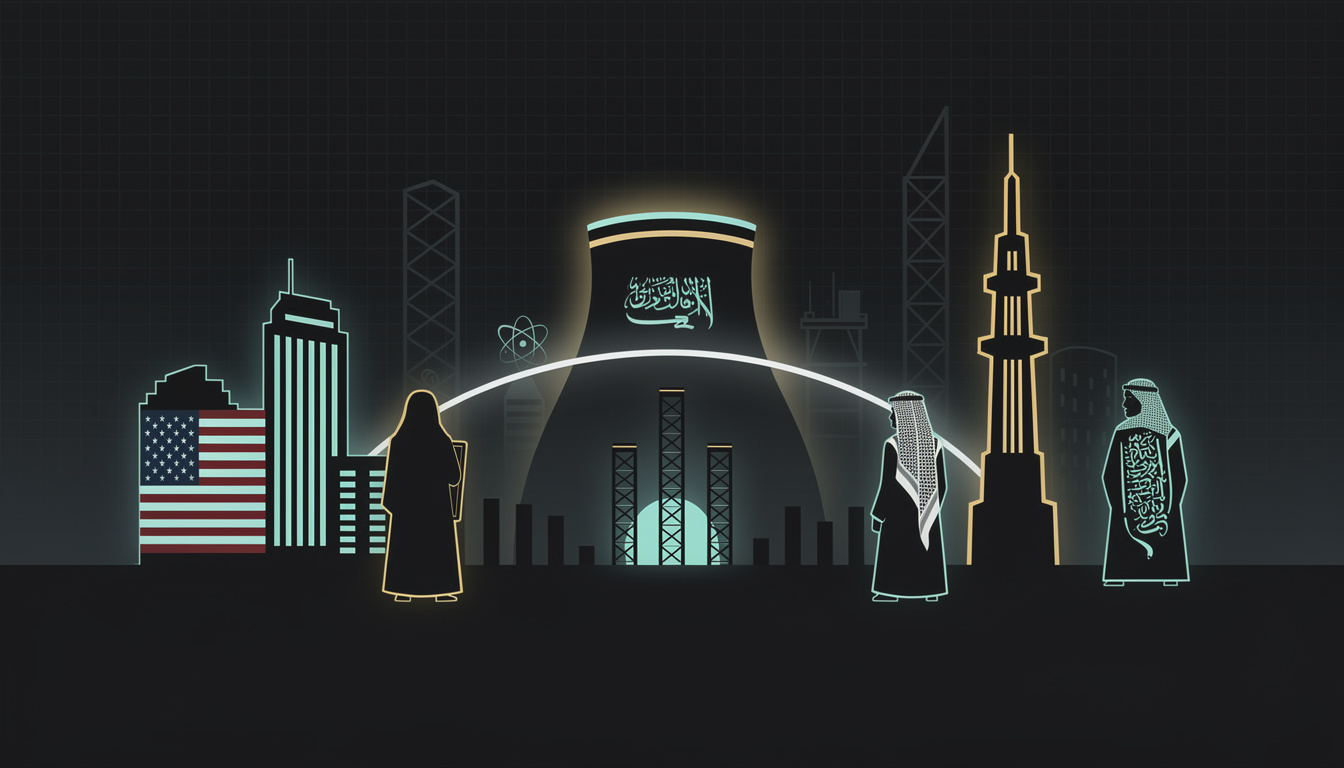 Symbolic image
Where things stand
The US-Saudi partnership remains at the stage of announcement rather than execution, and the sharpest point of contention is still the nuclear track, where Washington has agreed to let Saudi Arabia operate a uranium enrichment programme — the element that separates this from conventional civil nuclear cooperation and the reason the arrangement has revived warnings of a nuclear arms race in the Middle East. Riyadh has not ruled out building weapons should Iran do so, while its stated case rests on long-standing economic calculations about dependence on oil, budget deficits and rising domestic electricity demand. The event framing also cites a US intelligence assessment describing Iran's new leadership as more open to weaponisation; that claim is not detailed in the available source material and should be treated as unconfirmed. What has shifted is that the political argument in Washington is now running on two fronts. The New York Times reports that President Donald Trump is pushing a broader nuclear energy agenda of which the Saudi agreement forms part, and that his family and close supporters hold overlapping business interests that could position them to benefit, while a Wall Street Journal opinion piece argues the deal invites disaster. Scrutiny has therefore widened from the proliferation risk alone to the question of who stands to gain from the policy, though nothing in the sources indicates ratification, licensing or construction.
The financial track remains the more concrete of the two. Saudi Arabia's Public Investment Fund signed a framework agreement on Friday with the US Export-Import Bank worth up to $15 billion, alongside separately announced accords of up to $9.5 billion with two private-sector arms of the World Bank — documented instruments, even if no drawdown or project has yet been attached to them. Together the strands describe a deeper financial and technological alignment in which the nuclear agreement supplies the strategic framing and the Exim and World Bank arrangements supply the money. One data point still cuts against a simple story of expansion: a lower US equity figure reported for May suggests the fund has been trimming its listed American holdings even as it enlarges procurement and project financing, pointing to a shift in the form of its US exposure rather than its size. The substance of the nuclear deal, and of the enrichment provision in particular, will only become testable once implementation details emerge, and the conflict-of-interest questions now attached to it are likely to shape how much political room that implementation has.
Saudi Arabia has long sought a civil nuclear programme, and any cooperation with the United States touches on the wider regional question of nuclear technology, including Washington's parallel effort to prevent Iran from building a weapon. The Public Investment Fund is the Saudi sovereign wealth fund and the main vehicle through which the kingdom deploys capital abroad and finances domestic projects. The US Export-Import Bank is the American government's export credit agency, whose framework agreements are designed to support purchases of US goods and services. The World Bank's private-sector arms provide financing and guarantees for commercial projects rather than lending to governments. This topic tracks how the nuclear and financing tracks develop from announcement toward — or short of — actual implementation.
Timeline in detail
Monday, 27 July 2026 · GeopoliticsTrump pushes Saudi nuclear deal as critics warn of proliferation
The New York Times reported that President Donald Trump is advancing a nuclear energy agenda that includes an agreement with Saudi Arabia, and that his family and close supporters have overlapping business ties that could position them for gains. A Wall Street Journal opinion piece argued the Saudi nuclear deal invites disaster.
Sunday, 26 July 2026 · GeopoliticsUS-approved Saudi uranium enrichment revives Middle East arms-race fears
US-approved Saudi uranium enrichment revives Middle East arms-race fears
Washington's agreement to let Saudi Arabia operate a uranium enrichment programme has reignited warnings of a nuclear arms race in the Middle East. Riyadh has not ruled out building weapons if Iran does, but its nuclear ambitions also rest on decades-old economic calculations about oil dependence, budget deficits and rising electricity demand. The cooperation agreement, announced alongside a $15bn finance pact, remains at the announcement stage rather than in execution.
Folha de S.Paulo
Saturday, 25 July 2026 · GeopoliticsUS and Saudi Arabia agree civil nuclear cooperation as PIF signs $15bn US finance pact
US and Saudi Arabia agree civil nuclear cooperation as PIF signs $15bn US finance pact
The US president has announced a civil nuclear agreement with Saudi Arabia while continuing to press Iran not to build a nuclear weapon. In parallel, Saudi Arabia's Public Investment Fund signed a framework agreement with the US Export-Import Bank worth up to $15 billion, plus further accords of up to $9.5 billion with two private-sector arms of the World Bank. The two strands together mark a deeper financial and technological alignment between Washington and Riyadh.
The National · The Guardian