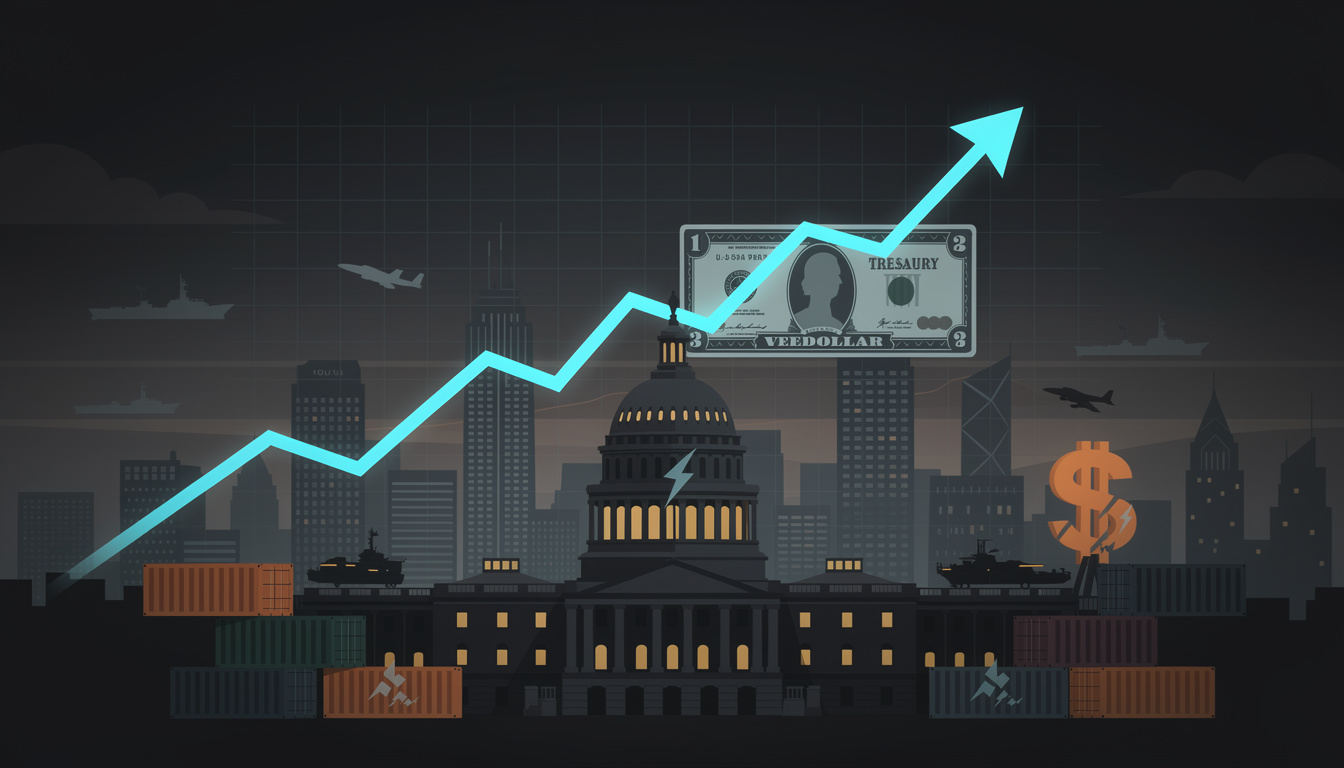
 Symbolic image
Fed holds rates at 3.50 to 3.75 percent, three officials vote for a hike
The US Federal Reserve left its target range at 3.50 to 3.75 percent on Wednesday, but three of its twelve voting officials broke ranks and pushed for an increase. Fed chair Kevin Warsh insisted the central bank still defines price stability as 2 percent inflation, while core inflation stands at 3.4 percent. Treasury yields, the dollar, gold and US equities all moved on the decision.
Iran United StatesFederal Open Market CommitteeFederal Reserve System
What happened
The Federal Reserve announced after a two-day meeting of its open market committee on Wednesday that it is leaving the benchmark rate in the range of 3.50 to 3.75 percent. Three of twelve central bankers voted against the decision and argued for a small increase to keep inflation in check, according to FAZ. Core inflation excluding energy and food had risen to 3.4 percent in May on the gauge the Fed has so far preferred, above the 2 percent target, while a different indicator eased slightly in June. At his news conference, Warsh rejected the idea that the Fed has quietly settled on a higher target: "Let me stress: there is no soft inflation target." He pointed to what he called the impressive robustness of the US economy, with barely changed unemployment, stable consumer spending and striking growth in investment tied to the expansion of artificial intelligence. Fed officials had attributed the recent flare-up in inflation to one-off events such as the new tariffs and the Iran war.
The New York Times reported that government borrowing costs climbed to a two-decade high before losing steam after the hold; the New York Times also reported that the dollar fell to its weakest in nearly a week, gold rose and US stocks slid after the pause and an escalation in the Iran war.
The view from outside
The German paper FAZ frames the split vote as a sign that several officials are losing patience. It notes that Warsh, before his nomination, had promoted the thesis that the AI revolution dampens price pressure through large productivity gains and therefore justifies lower rates, and that the Fed has examined at length whether AI investment is instead fuelling inflation as prices for memory chips and AI infrastructure rise. The stated worry is that inflation expectations slip and that a prolonged miss of the target erodes the Fed's credibility.
What could happen next
The dissent of three officials makes the next meeting the point at which the direction of policy is decided rather than merely confirmed. Warsh's explicit commitment to 2 percent, paired with core inflation at 3.4 percent, leaves the Fed defending a gap it has not closed for months. Bond investors are pricing that uncertainty directly: The New York Times quoted Apollo's Torsten Slok describing a yo-yo bond market fed by the Fed's new silence, and reported that markets had braced for one of the most uncertain Fed days in years. Whether the tariffs and the Iran war keep being treated as one-off shocks, and whether AI investment turns out to raise or lower price pressure, will shape both the committee's next vote and the path of long-dated Treasury yields.