
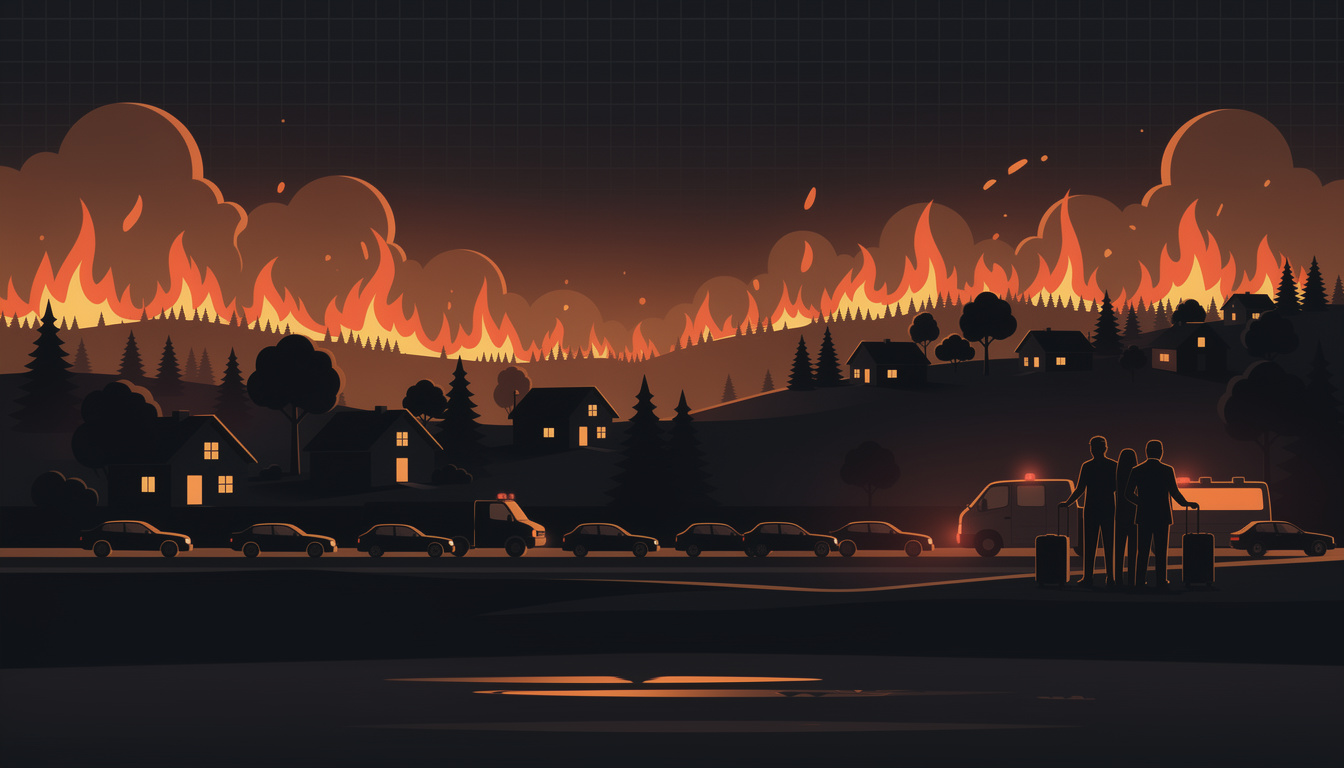
 Symbolic image
Wildfires in France and Spain force hundreds of thousands from their homes
Fires in the Gironde region around Bordeaux and in the mountains south-west of Madrid have driven more than 300,000 people from their homes, according to Bloomberg, in what French media and officials describe as the country's largest evacuation since the Second World War. In France alone 220,000 people are covered by evacuation orders and 42,000 hectares have burned; in Spain two fires in the Madrid and Ávila regions have merged into what FAZ calls the largest wildfire in the country's recent history. Both governments have mobilised soldiers and aircraft, while evacuated residents in Spain accuse the authorities of neglect.
What happened
Two fire complexes are burning simultaneously in south-western France and central Spain. In the French département of Gironde, interior minister Laurent Nuñez said on Sunday that 42,000 hectares had burned and that 220,000 people were affected by evacuation orders; five further communes were evacuated overnight, covering 55,000 people, and around 240 homes were destroyed. According to the ministry, 84 firefighters have been injured. The fire generates its own wind and advanced to within 15 kilometres of the boundary of the Bordeaux metropolitan area, roughly 17 kilometres from the city centre and 25 to 30 kilometres from the city limits, as mayor Thomas Cazenave put it. Holiday areas on the Cap Ferret peninsula, around the Arcachon basin and at Biscarrosse were cleared; more than 7,000 people took shelter in the Bordeaux exhibition centre, which has room for 10,000. France raised the number of soldiers supporting firefighters from 500 to 1,000, deployed 18 firefighting aircraft including a converted A400M that can drop up to 20 tonnes, and sent 1.5 million FFP2 masks to the region. The prefecture described the night into Monday as "generally stable", with rain falling. In Spain, almost 40 villages have been emptied since Thursday and, by Sunday, more than 100,000 people had been brought to safety, according to FAZ, which elsewhere cites official figures of about 63,000 Spaniards forced from their homes or cut off. More than 3,400 personnel and around 30 aircraft were operating in the Madrid and Ávila regions. The fires from Madrid and Ávila merged into a single large blaze; on Sunday the wind eased. The government declared the Madrid region and the province of Toledo disaster areas. Aggregate figures differ between outlets: Handelsblatt reports 240,000 evacuated across both countries, Bloomberg more than 300,000.
The camps
The French government stresses both scale and limits. Nuñez called the situation at the gates of Bordeaux "very unfavourable" and said the fire was "spreading uncontrolled in the direction of the Bordeaux metropolitan area", adding that an evacuation of the city should be avoided but could not be ruled out. Mayor Cazenave said an evacuation of the roughly one million inhabitants of the metropolitan area was "out of the question" because the fire lay to the south and was not advancing westwards; he nonetheless activated the metropolitan evacuation plan. Firefighters quoted on French news channels were more pessimistic, one saying: "The fire is out of control. I have never experienced anything like it." In Spain, prime minister Pedro Sánchez announced from the command post at Cenicientos that the entire Spanish state would use all its resources to stop the fire. Lieutenant General Francisco Javier Marcos Izquierdo of the military emergency unit UME said in the evening: "The fires are not yet under control, but the situation is under control." Evacuated residents contradict that reassurance. A tradesman quoted by FAZ said: "Before the fire the politicians didn't care about anything. They are to blame for people's houses burning down now." Similar accusations were heard across the weekend.
The view from outside
Outlets outside the two affected countries frame the fires as a European rather than a national event. The Wall Street Journal headlines wildfires raging "across Europe" and threatening the Bordeaux region; the Financial Times describes "violent" fires close to French and Spanish cities; Bloomberg leads on the displacement figure of more than 300,000. The New York Times places the fires in a climatic frame, noting that the affected parts of France and Spain had already experienced unusually hot and dry summers, and reports from Spanish shelters where people sleep in halls or in their cars, some evacuated more than once as the flames advanced, waiting to learn whether their homes are still standing. No Gulf, Chinese or Global South sources are present in this selection.
What's new
A day earlier the reported total was close to 300,000 people ordered to evacuate or shelter indoors across both countries, with more than 25,000 moved to safety around Bordeaux, including on the Cap Ferret peninsula. Since then the French figure alone has risen to 220,000 people under evacuation orders in Gironde, the fire has closed to 15 to 17 kilometres from Bordeaux, the metropolitan evacuation plan has been activated and the military contingent doubled to 1,000. New on the Spanish side are the merger of the Madrid and Ávila fires into one blaze, the disaster-area declaration for the Madrid region and Toledo province, and a first cautious easing of alarm by the UME after the wind dropped on Sunday. The night into Monday brought rain and a stable front in Gironde.
What could happen next
If the calmer winds and the rain reported in Gironde hold, containment lines could stabilise and the first evacuees might be allowed back, shifting attention to the roughly 240 destroyed homes and to compensation for a summer tourism season interrupted at its peak. Should the fire regain intensity and continue to generate its own wind, the French debate would move to the question Nuñez has so far left open: partial evacuation of parts of the Bordeaux metropolitan area, with corresponding demands on shelter capacity beyond the 10,000 places currently available. In Spain, the disaster-area declarations for Madrid and Toledo open a reconstruction and payments process that will run alongside the accusations of neglect now being levelled at national and regional authorities, and both governments face pressure to explain their prevention and staffing decisions before the next heat episode.