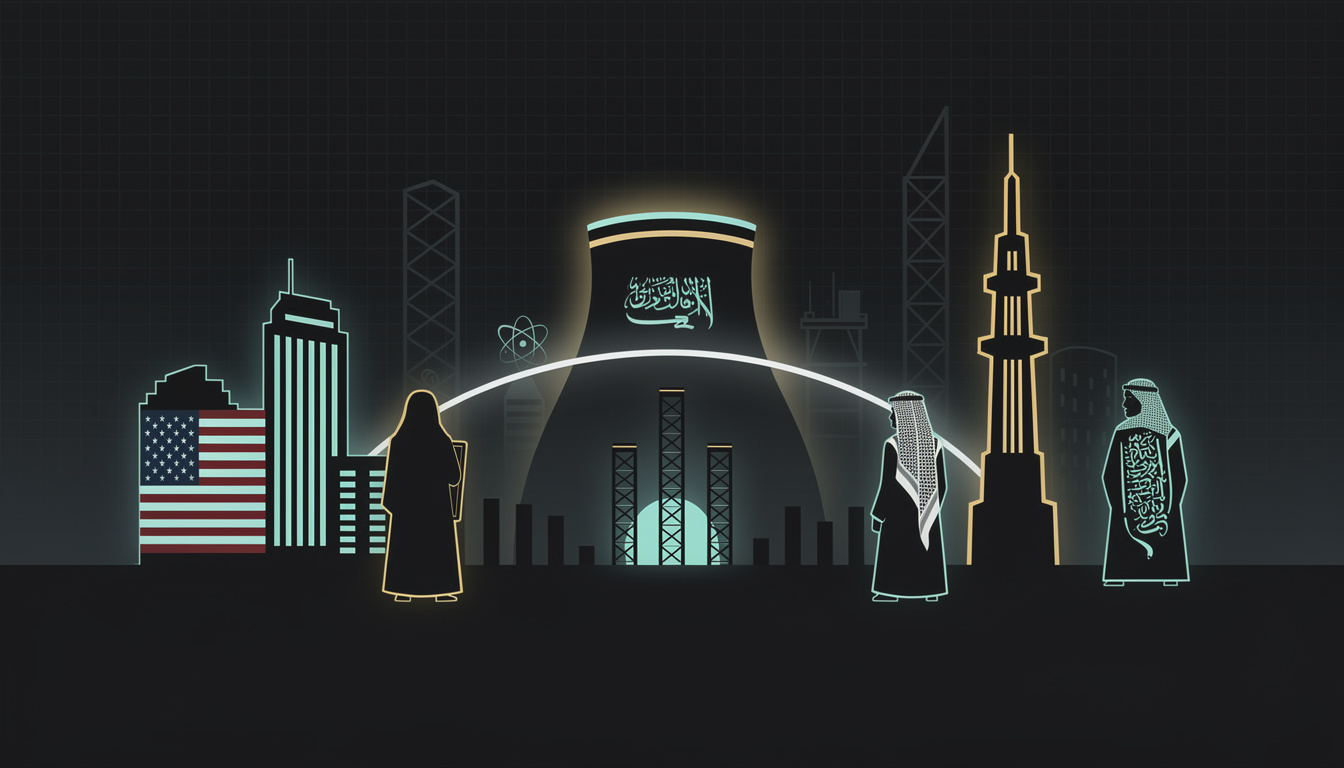
 Symbolic image
US and Saudi Arabia agree civil nuclear cooperation as PIF signs $15bn US finance pact
2 sources
The US president has announced a civil nuclear agreement with Saudi Arabia while continuing to press Iran not to build a nuclear weapon. In parallel, Saudi Arabia's Public Investment Fund signed a framework agreement with the US Export-Import Bank worth up to $15 billion, plus further accords of up to $9.5 billion with two private-sector arms of the World Bank. The two strands together mark a deeper financial and technological alignment between Washington and Riyadh.
Iran Saudi Arabia United StatesInternational Finance CorporationPublic Investment FundUS Export-Import BankWorld Bank
US and Saudi Arabia seal nuclear cooperation deal and $15bn finance pact
What happened
Both available accounts agree on the outline of a two-part package. On the political track, the US administration announced a nuclear agreement with Saudi Arabia, presented by Washington as a landmark step and pursued alongside continued US efforts to prevent Tehran from developing a nuclear weapon, according to The Guardian. The detailed terms of that agreement are not set out in the material available here; what it contains, and how it will be handled politically in Washington, is described by The Guardian only as a subject of debate and potential challenge. On the financial track, the details are firmer. The Saudi Public Investment Fund said it signed an agreement with the US Export-Import Bank on Friday worth up to $15 billion. According to the PIF, the accord creates a framework for long-term financing that allows eligible PIF portfolio companies to buy US goods and services, and covers cooperation in advanced technology, space and aviation, infrastructure, future mobility, water and minerals. The fund said the United States remains its largest international market, with procurement totalling $65 billion since 2017. In the same round, the PIF announced agreements of up to $9.5 billion with two private-sector arms of the World Bank: $6 billion with the International Finance Corporation for co-financing in infrastructure, energy, transport, tourism and health care, and $3.5 billion with the Multilateral Investment Guarantee Agency to explore guarantees enabling financing for PIF portfolio companies across the Middle East and North Africa.
The camps
The two directly involved sides describe the package in different registers rather than contradicting each other. Washington presents the nuclear component as a win it has delivered to Riyadh, framed within a wider non-proliferation policy aimed at keeping Iran from a weapon, per The Guardian's account. Riyadh, speaking through the PIF, frames its side almost entirely in economic terms: the agreements are described as instruments for financing, procurement and industrial development, with no reference to the nuclear track in the fund's own statements. MIGA, as counterparty, said its partnership with the PIF aims to support what it called one of the central engines driving Vision 2030 by attracting international investors and promoting projects that create jobs across its member countries. No Iranian statement appears in the sources available, so Tehran's reading of the nuclear agreement is not documented here.
The view from outside
Coverage outside the two governments splits along the same lines. The Emirati outlet The National, state-affiliated, treats the events as a business story: it lists the sums, the sectors and the fund's US exposure, noting that the PIF's US equity portfolio stood at $12 billion in May, down from $12.9 billion in December according to a filing with the Securities and Exchange Commission, with stakes in Claritev, Electronic Arts, Lucid Group and Uber. It does not mention the nuclear agreement. The British Guardian, left-liberal, foregrounds the nuclear dimension instead, asking what is driving the agreement with Riyadh and how it will be received both domestically in the United States and across the Gulf.
What's new
The concrete new step is the signature itself: the PIF-Exim framework was signed on Friday, moving the US-Saudi economic relationship from announced intent to a documented financing instrument, alongside the separately announced World Bank accords. The nuclear agreement is likewise newly announced rather than newly implemented; the sources describe an announcement and its political reception, not ratification or construction. The lower US equity figure reported for May also runs counter to the direction of the new commitments, showing the fund trimming listed US holdings while expanding procurement and project financing.
What could happen next
One path is that the financing framework is used as designed, with PIF portfolio companies drawing on Exim-backed credit to buy US goods and services in the named sectors, which would raise Saudi procurement from the United States above the $65 billion recorded since 2017 and pull the World Bank arms into MENA projects through guarantees and co-financing. A second path runs through Washington's own institutions: The Guardian points to political challenges the nuclear agreement could face, and scrutiny in Congress over defence and foreign-policy terms could slow, condition or reshape what is implemented. A third concerns the regional reading: because the nuclear track is being advanced at the same time as pressure on Tehran, other states in the region may weigh the agreement's enrichment and safeguards terms against their own positions, though no such reaction is documented in the sources available.
United States
United States
Presents the nuclear agreement as a landmark deal for Riyadh and part of a wider effort to stop Iran from obtaining a weapon.
Saudi Arabia
Saudi Arabia
Describes the package in economic terms, as financing and procurement infrastructure serving Vision 2030.
Also involved
Iran
Worth reading
Sources