Gulf mediators and Iran agree to keep talking as US strike threat loomsIsrael votes at record turnout in election too close to callCongo Ebola cases pass 10,000 as neighbours tighten quarantineHouthis claim missile strike on Ras Tanura as Egypt backs RiyadhOleshky truce holds as Nordic leaders speak with PutinDrone strikes kill 21 in Nyala and cut power across Sudan as states warn of famineChurch reports 60 Orthodox Christians killed in two Oromia attacksIndia evacuates eastern coast as very severe Cyclone Arnab nears landfallJordan strikes southern Syria after church attack, Damascus protestsAnthropic's IPO filing shows heavy losses and warns of existential risksRussian strikes damage Kyiv's South Bridge and cut power in seven regionsFlávio Bolsonaro leaves for US as Brazil cancels his passportsOil holds near $115 while gas, fuel costs and inflation stay highChina's AI stocks keep falling despite state supportFrench student groups reject concessions as finance minister rules out new spendingAI stocks rebound as Meta raises equity and Anthropic files for IPOHebron displacement nears 5,000 as officers expect pullout after voteTwo men charged over RAF Fairford incidentStudent List wins Serbian election as Croatia demands acknowledgement of 1990s warsIndonesia and Singapore plan haze task force amid tensionsBrazil's real suffers worst day in over 25 years after Lula comebackIran threatens legal action against Sinokor ships over HormuzUN commission says Israel continued genocide in Gaza after ceasefireGas exporters meet in Moscow as Iranian and Qatari leaders hold talksIndonesian bond yield hits four-year high as MSCI risk and oil weighFrench consumer confidence hits 13-year low amid protestsGulf mediators and Iran agree to keep talking as US strike threat loomsIsrael votes at record turnout in election too close to callCongo Ebola cases pass 10,000 as neighbours tighten quarantineHouthis claim missile strike on Ras Tanura as Egypt backs RiyadhOleshky truce holds as Nordic leaders speak with PutinDrone strikes kill 21 in Nyala and cut power across Sudan as states warn of famineChurch reports 60 Orthodox Christians killed in two Oromia attacksIndia evacuates eastern coast as very severe Cyclone Arnab nears landfallJordan strikes southern Syria after church attack, Damascus protestsAnthropic's IPO filing shows heavy losses and warns of existential risksRussian strikes damage Kyiv's South Bridge and cut power in seven regionsFlávio Bolsonaro leaves for US as Brazil cancels his passportsOil holds near $115 while gas, fuel costs and inflation stay highChina's AI stocks keep falling despite state supportFrench student groups reject concessions as finance minister rules out new spendingAI stocks rebound as Meta raises equity and Anthropic files for IPOHebron displacement nears 5,000 as officers expect pullout after voteTwo men charged over RAF Fairford incidentStudent List wins Serbian election as Croatia demands acknowledgement of 1990s warsIndonesia and Singapore plan haze task force amid tensionsBrazil's real suffers worst day in over 25 years after Lula comebackIran threatens legal action against Sinokor ships over HormuzUN commission says Israel continued genocide in Gaza after ceasefireGas exporters meet in Moscow as Iranian and Qatari leaders hold talksIndonesian bond yield hits four-year high as MSCI risk and oil weighFrench consumer confidence hits 13-year low amid protests
Bota
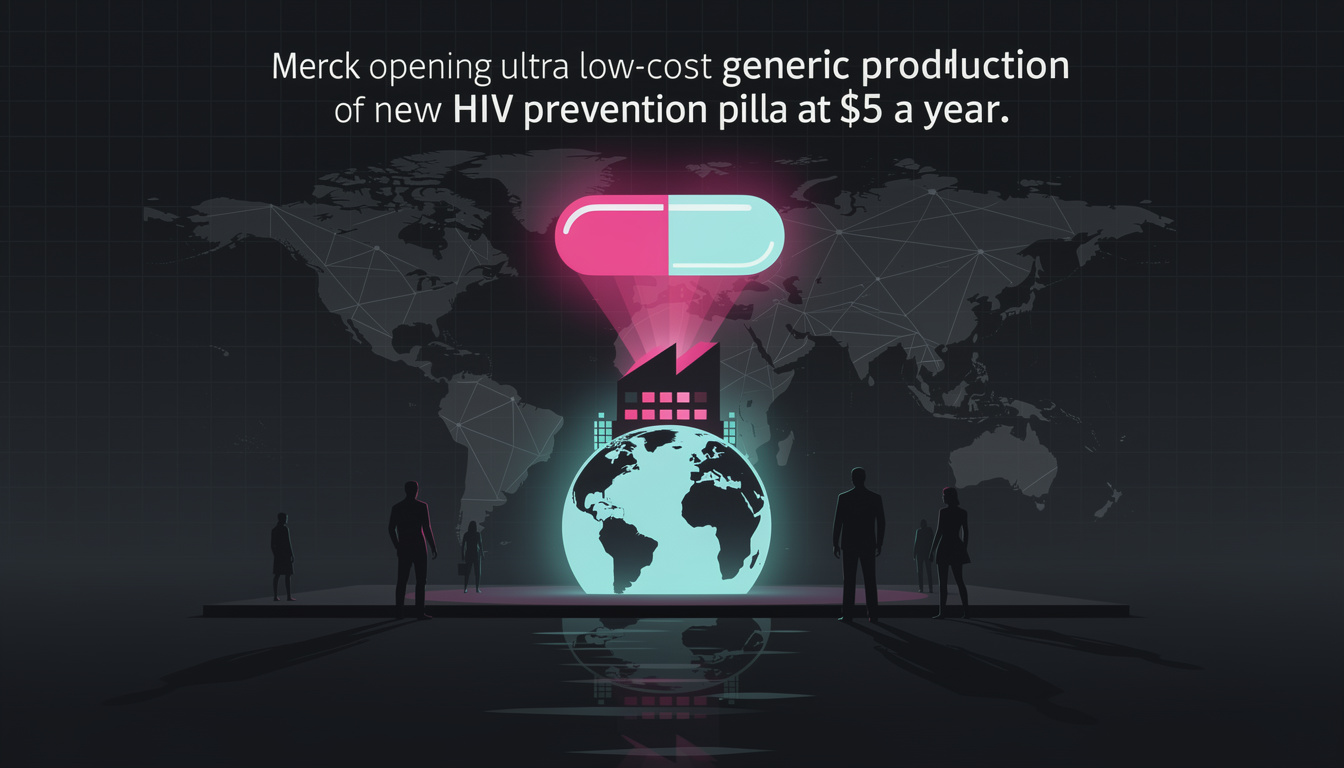
Symbolic image: Merck licenses generic production of new HIV prevention pill at about $5 a yearSymbolic image

Merck licenses generic production of new HIV prevention pill at about $5 a year

1 source

Merck has arranged for companies in Africa and India to manufacture generic versions of its new HIV prevention pill, which could cost as little as $5 per person per year, according to the New York Times. The step is aimed at the regions carrying the heaviest HIV burden. Access in much of Latin America remains uncertain.

What happened

According to a report published by the New York Times on 24 July 2026, the US pharmaceutical company Merck has taken steps to secure broad access to a new pill for HIV prevention that has raised high expectations among researchers and public-health bodies. Under the arrangement described in the report, manufacturers based in Africa and in India will be permitted to produce generic versions of the drug. The price named for those generics is as little as five US dollars per person per year. The same report states that access to the drug, and to other new HIV products, remains uncertain across much of Latin America. Beyond these points, the material available for this article contains no further verified detail: it does not identify the licensed manufacturers, does not give a start date for production or first deliveries, does not specify the volumes involved, and does not list which countries are covered by the licences. The clinical results behind the description of the pill as promising are likewise not quantified in the source. Only one outlet is available on this event, so every element above rests on a single report and should be treated as unconfirmed by independent reporting.

The camps

The available material does not set out opposing positions from named parties. The only fault line it records is geographic: the licensing covers production in Africa and India, while Latin America is described as a region where access to this drug and other new HIV products is still unclear. No statement from Merck, from the licensed manufacturers, from affected governments or from health organisations is quoted in the source, so neither a company rationale nor any criticism of the arrangement can be reported here.

What's new

This is the first entry in the topic. The new element compared with the preceding period is the move from a drug regarded as promising to a concrete manufacturing and pricing arrangement: generic production licensed to companies on two continents, and a stated figure of around five dollars per person per year. What has not changed, according to the same report, is the situation in much of Latin America, where access is described as uncertain.

What could happen next

If licensed production proceeds as described, generic supply at the named price would make the pill affordable for national prevention programmes in countries with high HIV incidence, though the timeline from licence to delivered doses is not set out in the available material and would depend on regulatory approvals and manufacturing capacity that the source does not describe. A second path runs through the gap the report itself identifies: middle-income countries, particularly in Latin America, may fall outside the licensed territories and face negotiations over price or supply separately from the regions covered now. It is also possible that the arrangement remains partial in practice, with the headline price applying to some buyers or volumes and not others; the source gives a figure but no conditions attached to it, so how widely the five-dollar level applies cannot be assessed from the material at hand.

To the edition