
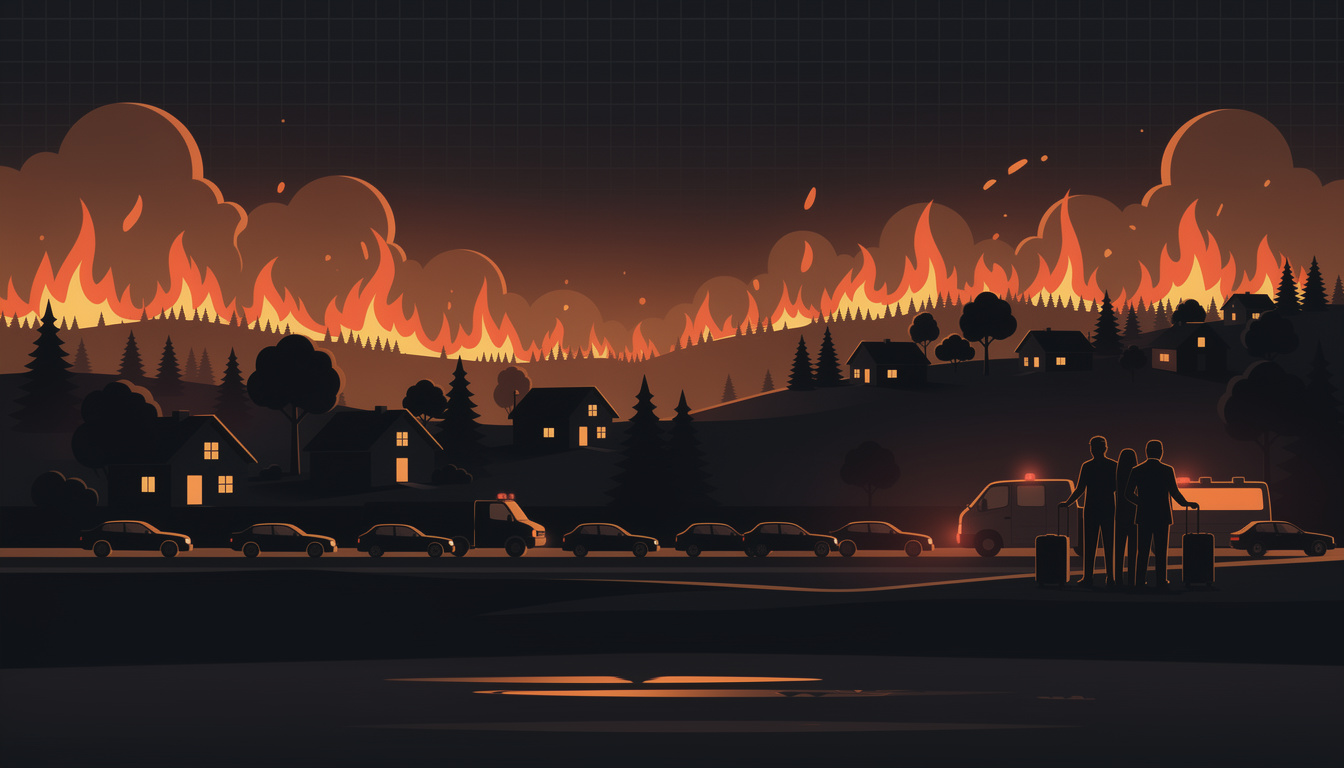
 Symbolic image
Wildfires in France and Spain force tens of thousands to flee; Madrid declares national emergency
2 sources
Fast-moving wildfires driven by extreme heat, drought and wind forced more than 25,000 people from campsites and homes around Bordeaux in southwestern France on 24 July 2026, including the Cap Ferret peninsula, while Spain declared its first national emergency over a wildfire after more than 10,000 people were evacuated near Madrid and in Ávila province. Both governments requested help through the European Union, which dispatched water-bombing aircraft. Two firefighters had already died near Bordeaux earlier in the week, and Spain counts 13 wildfire deaths so far in 2026.
Spain FranceEU Civil Protection MechanismEuropean UnionMilitary Emergency Unit (UME)Spanish Military Emergency Unit (UME)
Wildfires force mass evacuations in France and Spain, Madrid declares emergency
What happened
According to reporting by the New York Times and by Daily Sabah citing AFP and Reuters, wildfires burned simultaneously in southwestern France and central Spain on Friday, 24 July 2026, fuelled by extreme heat, drought and strong winds. In France the worst blazes were in the Gironde region near Bordeaux, where fire moved through pine forest and Atlantic coastal tourist areas and forced more than 25,000 people to leave campsites, holiday homes and surrounding communities. Authorities put the largest fire at about 4,800 hectares (11,860 acres) and a second blaze south of Bordeaux at about 1,200 hectares. Around 800 firefighters with 260 vehicles, five water-bombing aircraft and a helicopter were deployed against the biggest fire; one firefighter was injured, and two firefighters had died earlier in the week fighting a separate fire near Bordeaux Airport. On the Cap Ferret peninsula, one of France's busiest summer destinations, tourists left by boat as roads came under threat. In southern France, mistral winds drove dozens of additional fires. In Spain, the government declared a national emergency late Thursday after several fires broke out at once near Madrid and in neighbouring Ávila province. More than 10,000 people were evacuated from Villa del Prado, San Martín de Valdeiglesias, Pelayos de la Presa and Aldea del Fresno, with more than 270 emergency personnel, 40 ground units and units of the Military Emergency Unit (UME) deployed. Both countries requested EU assistance.
The camps
France and Spain are not opposing parties here; both describe an emergency exceeding routine capacity, but with different emphasis. President Emmanuel Macron said the situation remained "under very high tension in the face of the fires ravaging the country, particularly in Gironde", and said France had activated the EU Civil Protection Mechanism, securing firefighting aircraft and helicopters from Croatia, Portugal, the Czech Republic and Slovakia; the European Union separately announced three water-bombing aircraft for France. Spain's Interior Ministry justified the national emergency declaration by pointing to multiple simultaneous fires, worsening weather and the need to coordinate resources across different levels of government. The Madrid regional government requested assistance and called the situation one of "extreme gravity", warning that fires in Villa del Prado, San Martín de Valdeiglesias and Almorox could outrun available firefighting capacity and that the Burgohondo fire in Ávila could reach the Madrid region within hours.
The view from outside
Both available outlets are based outside the affected countries and rely largely on agency material. Daily Sabah, Turkish and state-affiliated, frames the events as a cross-border "mass exodus" and foregrounds the EU's role as a collective responder, running the aircraft deployment in its headline. Its Reuters-based Spain report adds a climate framing that the French coverage does not stress: it notes that scientists attribute increasingly destructive wildfire seasons in southern Europe to climate change, and cites experts saying unusually heavy spring rainfall produced dense vegetation that dried out in extreme summer heat, leaving large amounts of flammable fuel. The New York Times, from the United States, keeps to the operational picture, describing the ordered evacuation of the Cap Ferret peninsula and fires closing in on populated areas west of Madrid.
What's new
This is the first entry on the topic. Two developments distinguish Friday from the preceding days. Spain's declaration was, according to authorities cited by Reuters, the first national emergency ever issued in the country over a wildfire, placing the response under the direct authority of the interior minister under the National Civil Protection System law. In France, the danger shifted from a firefighting operation to a mass evacuation of holidaymakers after the deaths of two firefighters near Bordeaux Airport earlier in the week. For scale, the same French area burned severely in 2022, when about 50,000 people were evacuated. In Spain, more than 100,000 hectares (247,000 acres) have burned this year, roughly the average annual figure of the past decade, and 13 deaths make 2026 one of the deadliest seasons in decades.
What could happen next
If heat, drought and the mistral winds persist, the fire perimeters around Bordeaux and west of Madrid could widen further and pull in more EU-supplied aircraft, with evacuation orders extended along the Atlantic coast and into the Madrid region should the Burgohondo fire cross the provincial boundary as the regional government warned. A change in weather, or the arrival of the additional aircraft from Croatia, Portugal, the Czech Republic and Slovakia, could instead allow crews to hold current lines, after which attention would turn to damage assessment in the evacuated tourist areas at the height of the summer season. A third path runs through policy: with Spain already at its decade-average burned area in July and its first wildfire-triggered national emergency on the books, the season could feed argument over civil protection funding, the division of responsibility between national and regional authorities, and the vegetation-management questions raised by the experts cited in the Spanish reporting.