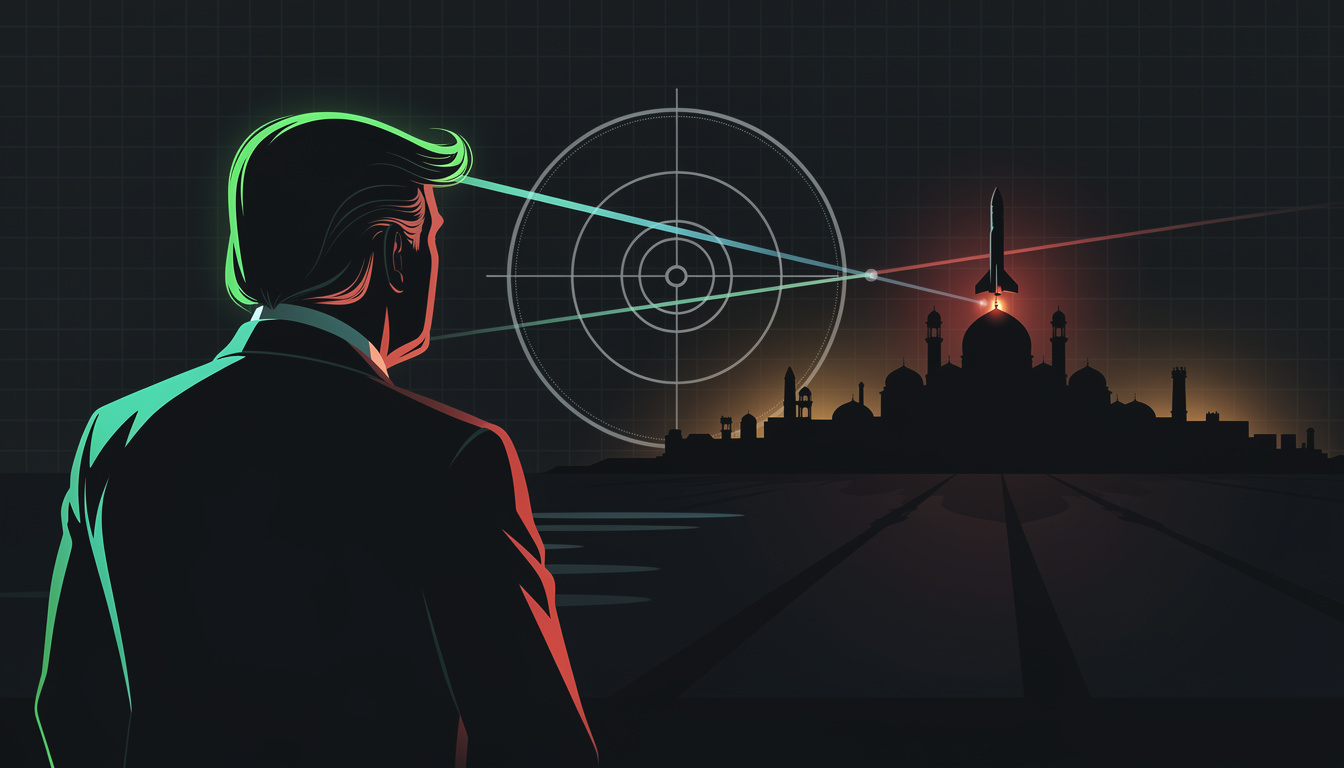
 Symbolic image
Trump weighs major escalation in Iran as US intelligence reassesses Tehran's nuclear course
1 source
According to the New York Times, President Trump met his most senior advisers on 24 July 2026 to consider a major escalation of the US-Israeli war against Iran, which has now run for nearly five months. In parallel, US intelligence agencies assess that Iran's new supreme leader, the son of the leader killed early in the war, is more open to pursuing a nuclear weapon than his father, who had renounced such weapons. The reporting available for this event comes from a single US outlet; there are no Iranian or Israeli statements in the material.
Israel Iran United States
Trump weighs major Iran escalation as intelligence sees new supreme leader open to the bomb
What happened
The war fought by the United States and Israel against Iran has been running for nearly five months, the New York Times reports. Trump had publicly presented the campaign as a relatively short "excursion"; the paper notes it has now lasted close to five months with no end in sight. On 24 July 2026, according to the same reporting, Trump met his most senior advisers to weigh a major escalation of that war. Separately, US spy agencies have arrived at an assessment of Iran's leadership: the supreme leader who was killed in the early phase of the war had renounced nuclear weapons, while his son, who succeeded him, is believed by those agencies to be more interested in building a bomb. Two points should be stated plainly. First, the intelligence finding is an assessment, not an established fact, and the sources give no evidence base, no timeline and no technical detail behind it. Second, all of the above rests on the reporting of one outlet from one of the warring countries; no source from Iran, Israel or a third party is present, so none of it can be corroborated across opposing camps here.
The camps
Only the American position is documented in the available material, and only indirectly. Washington's public line, as described by the New York Times, was that the war would be comparatively brief; the internal deliberation now under way concerns whether to widen it substantially. The US intelligence community's contribution to that deliberation is the judgment that Iran's new leadership is more willing than the previous one to move toward a nuclear weapon. Iran's own position appears in the sources only as reported through that US assessment. The previous supreme leader's renunciation of nuclear weapons is described as his stated position; his son's alleged openness to a bomb is an inference by foreign intelligence services, not a statement attributed to Tehran. Israel is named as a party to the war, but no Israeli statement, and no Israeli or Iranian account of the war's course, is contained in the material.
What's new
The war itself is not new; what is new is where the decision has moved. The topic context notes that the deliberation over widening the war has reached the top of the American decision chain, and the New York Times dates that meeting to 24 July 2026. The second new element is the intelligence assessment on the succession: earlier in the war, Iran's supreme leadership was publicly committed against nuclear weapons; the assessment now attributed to US agencies reverses that reading for the current leader. Nothing in the sources indicates that a decision on escalation has been taken.
What could happen next
One course is that the deliberations end in an expansion of the campaign, adding targets or means beyond what the past months have involved and extending a war Washington originally described as short. Another is that the meeting produces no widening, leaving the war at roughly its present shape while the leadership question in Tehran remains the central unknown for US planning. A third turns on the intelligence assessment itself: as long as the judgment about Iran's new supreme leader is contested, unverified or revised, it can serve as the argument both for military escalation and against it, and any confirmation or correction of it would reshape the American debate before it reshapes the battlefield.
United States and Israel
United States Israel
Waging a war they expected to be short, with Washington now weighing a major escalation on the basis of an intelligence assessment that Iran's new leadership is more open to a nuclear weapon.
Iran
Iran
Its position is not represented in the available sources; the previous supreme leader had renounced nuclear weapons, and his successor's stance is described only through US intelligence assessments.
Worth reading
Sources